Sparton was a collaboration between Barton Engineering and Spondon Engineering and for a short time in the 1970s the most powerful race bike in the world was built in a converted chapel in North Wales.
There Barry Hart built racing two-stroke engines and in 1974 he joined forces with the noted frame builder Spondon to create a race bike.
The partnership embarked on building a machine which had a 500cc square-four engine based on the Suzuki RG500. In fact, Rex White of Suzuki Great Britain was sufficiently impressed to ask Barton Engineering to develop a 350cc Suzuki for Barry Sheene. Barton then turned a Suzuki GT380 into a water-cooled engine, although still using the original crank and crankcases. The result was a very fast machine but the project came to nothing. The official story is that Suzuki Japan caught wind of what was going on and closed it down, although it may simply have been that it needed a lot more development and refinement.
Enjoy more Classic Racer Magazine reading.
Click here to subscribe & save.

Barton continued with work on its three-cylinder engine, making it much lighter, but eventually sold it in order to concentrate on building a 500cc motor. The first version had a 458cc displacement which evolved into a 525cc motor that used Yamaha pistons and made 100hp.
At the 1975 Isle of Man the world sat up and took notice when a Sparton 500, piloted by Martin Sharpe, would be recorded at 146mph. This was at a time when factory teams such as Kawasaki were performing little better despite having massive resources behind them – and certainly considerably more funding and workforce than Sparton. In 1976 Spartons took the top two positions at the North West 200, ridden by Martin Sharpe and Frank Kennedy respectively.
Development continued with a 497cc version of the engine purportedly capable of 160mph. Sparton built several machines for privateers, most notably for Graham Wood who clinched a dozen wins in 1977 on his Sparton.
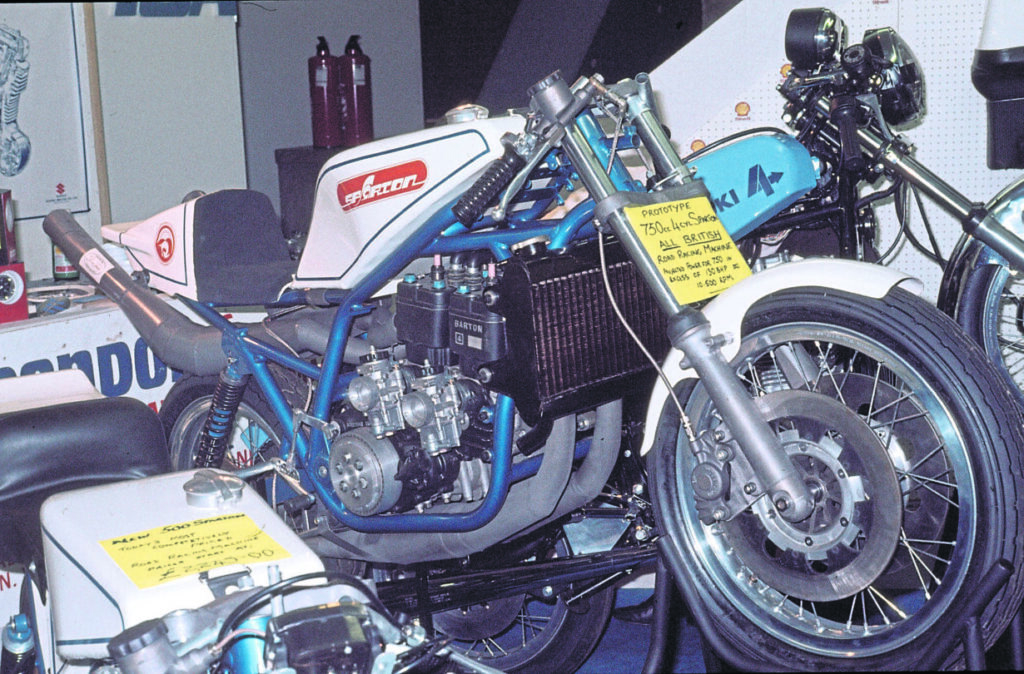
A 750cc square four called the Phoenix was launched, but there were certain reliability problems; Sparton stated that it wanted to sell engines to riders who “are prepared to work with us to solve any problems that may occur”; essentially, it wanted its own customers to act as guinea pigs and thus only a handful of Phoenix engines were made. Considering their limited numbers, Spartons were remarkably successful on the race track but eventually the company came to an end in 1982, unable to compete with the huge funding that the big four Japanese factories were prepared to pour into research and development. Eventually Barton was sold to Armstrong and then to Erik Buell, although he would later choose to pursue other ideas.
You may think you’ve never seen a Sparton, but we would wager you have – that is, if you’ve ever seen the film ‘Silver Dream Racer’ starring 1970s heartthrob David Essex in which Essex as ‘Nick Fletcher’ campaigns an experimental motorcycle built by his later brother. If you’ve never seen the movie we won’t spoil the ending, but you can probably guess! Barton made three machines for that movie, although only two were ever used on the screen.
Original article appeared in Old Bike Mart. To subscribe, click here: https://www.classicmagazines.co.uk/old-bike-mart